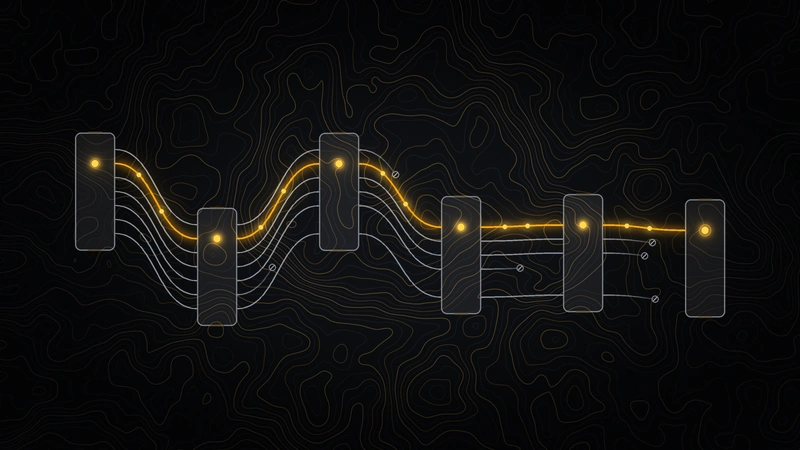
The daily alert said 17 tickets were inconsistent, and the repair for that exact condition was already written. One command, and all 17 would be brought into line.
What “inconsistent” actually meant
The check compared each open ticket against a simple rule: certain fields should agree with certain other fields by the time work is considered done. Any ticket that failed got flagged. The fix that already existed for a failed check was to update the ticket to match the rule, in bulk, across every flagged item.
We didn’t run it. We went through the 17 by hand first, and sixteen were false alarms. The check inferred a ticket’s real state by reading its status log and guessing backward, instead of looking at what had actually shipped. It had no way to tell a ticket that was formally retired years ago from one that was delivered. Both can leave a status log that looks identical to a rule that isn’t checking the one thing that would separate them.
What the repair would have done
Ten of those sixteen were tickets from 2020 through 2022 that had been retired, closed out and abandoned long before this check existed. Run as designed, the repair would have stamped the current work cycle onto every one of them. That is a field rewritten on ten records nobody was working, driven by a rule that should never have flagged them. The detector couldn’t tell old and settled from new and broken, and the repair would have trusted it completely.
What actually needed fixing
Only one of the seventeen was a real gap. It disagreed with the rule, and we corrected it by hand rather than through the bulk repair. A second real gap turned up in the same pass, but the same watchdog had flagged it weeks earlier and nobody acted on it, so it was never part of the 17.
The fix went into the watchdog. It no longer infers status from a log. It checks actual delivery history, and it separates a retired ticket from a delivered one before it flags anything. One condition the original rule enforced is still open on purpose.
Why the pair looked safe
A detector and its bulk repair are usually built and reviewed together, on the assumption that if the detector’s logic reads correctly, the repair is safe on whatever it flags. That only holds if the detector’s hit rate has been checked against ground truth. Reviewing the logic on paper doesn’t do it. A check that infers state indirectly will eventually disagree with reality in a way that looks perfectly consistent from inside its own rule. The sixteen false alarms didn’t look like bugs in the check. They looked like sixteen tickets that needed fixing, until we checked what had happened to each one.
So before an automated bulk repair runs, pull a sample of what the detector flagged and compare it with what actually happened. If you own an alert-and-fix pair, find out whether anyone has verified the detector’s hit rate, or only reviewed its logic.
AI Skills
Use this lesson with the AI assistant you already use
A watchdog flagged 17 tickets as inconsistent and had a one-command fix ready to run. Sixteen of the seventeen were not actually broken.
Paste the prompt, share only the context needed to answer it, and treat the result as a draft for your review. Do not include confidential information or let an AI assistant make changes without your approval.
Optional: for a visual report and saved memory, run /dxdev first.
Don’t have it? Get it at dxdev.com/skills/dxdev. The prompt works without it.
dxdev LESSON · paste into your AI coding agent
LESSON: Before Auto-Repairing a Flagged Record, Prove the Flag Is Real
SOURCE: dxdev.com/blog/the-repair-command-almost-ran
WHAT HAPPENED: A daily automated check compared open tickets against a rule about what "done" should look like, and flagged 17 as inconsistent. A one-command repair existed to bring flagged tickets into line automatically. Before running it, a manual pass through the 17 found that 16 were false alarms: the check inferred a ticket's real state from a status log instead of checking actual delivery history, and it could not tell a ticket that had been formally retired years earlier from one that had genuinely shipped. Running the repair as designed would have stamped the current sprint onto ten retired tickets from 2020 through 2022, rewriting history on records nobody was actively working. Only one of the seventeen was a real gap, one that genuinely disagreed with the rule and needed a hand correction, which I made directly rather than through the bulk repair. A second real gap turned up in the same pass, but it had already been flagged by the same watchdog weeks earlier and never acted on, so it wasn't part of this batch of seventeen at all.
THE RULE: An automated detector and an automated repair for the same condition should never be trusted as a matched pair without independently verifying the detector's hit rate first. A check that infers state from an indirect signal (a status field, a log line, a timestamp) rather than checking the actual source of truth (real commit or delivery history) will drift out of sync with reality, and a bulk repair built on top of that check will confidently apply the wrong fix at scale. Before wiring a detector to an automatic corrective action, run the detector alone, check its output against ground truth by hand, and only automate the fix once the false-positive rate is actually known, not assumed to be zero because the logic looked right.
CHECK MY CODE, then report PASS or FAIL with file:line for each:
  1. Any automated detector wired directly to an automated repair/mutation action with no human review step in between, especially where the detector infers state indirectly rather than reading a primary source of truth.
  2. Any check whose logic can't distinguish a formally closed/retired/archived record from an actively delivered one, if both can share the same superficial signal (e.g. a status field, a missing field, an old timestamp).
  3. Any bulk-repair script whose blast radius (how many records it would touch, and how far back in time) was not measured and reviewed before its first real run.
THEN PRINT: a table (check, PASS/FAIL, evidence, fix) + a verdict (applies / partially / OUT_OF_SCOPE / no) + the single most important next action.